
Member Login

Sign in with your FLA member email.

Forgot password?

Your membership account is managed by WildApricot.

Florida Lighthouses

St. Marks
Panhandle Region

St. Marks

St. Marks
Constructed 1829-1830, 1842. First Lighted 1831,1842. On National Register Listing.

At a Glance

Region
Panhandle Region
Type
Historic Lighthouse
Latitude
30.07384
Longitude
-84.17968

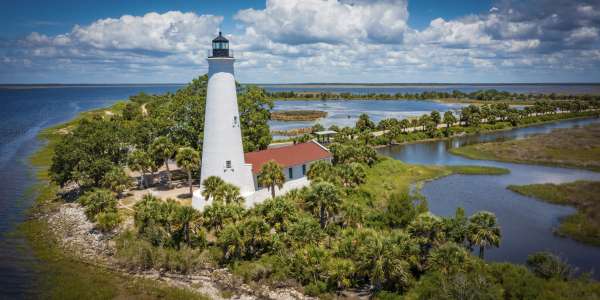
St. Marks Lighthouse


Photo: Nick Baldwin
Active: Yes

Characteristics: Occulting white light every four seconds (electric flasher)

Height: 88 feet, 85 steps

DayMark: White-washed conical brick tower with a black lantern

History: Constructed 1829-1830, 1842. First Lighted 1831,1842. On National Register Listing.

Lens: Original: Fifteen Lewis Argand lamps with fourteen-inch reflectors; Winslow Lewis (1831). Present: Forth-order fixed Fresnel lens; Henry-Lepaute (1867). Focal Plane: 82 feet.

Construction: Architect: Winslow Lewis. Builder: Benjamin Beal and Jairus Thayer (first tower); Calvin Knowlton (second and third towers). Conical brick tower constructed of brick and iron.

Other Buildings: Attached 1871 keeper's dwelling.

Coordinates:
     30 04 18 N
     84 10 48 W

Operated by: United States Coast Guard & St. Marks National Wildlife Refuge

Visit Status: Grounds Only

Days Open: Refuge Open Daily

Facilities: None, no handicap access

Hours Open: Refuge is open 8:00 am to 4:30 pm

Visitor Info: Grounds only, access through St. Marks National Wildlife Refuge.

Admission: Free ($5.00 admission to the Wildlife Refuge)
 
Contact:
St. Marks National Wildlife Refuge
P.O. Box 68
St. Marks, FL 32355

Email: saintmarks@fws.gov
Back to Lighthouse List>

Overview

The 88-foot St. Marks Lighthouse stands at the end of a long refuge road where marsh, river, and Gulf meet. Its white brick tower, black lantern, and attached keeper’s dwelling form a striking landmark in one of Florida’s richest wildlife habitats.

History

An initial lighthouse was completed near St. Marks in 1830, but erosion soon required a safer site. The present tower was erected farther inland in 1842 and withstood major hurricanes in 1843 and 1851. During the Civil War, Confederate troops used the station as a lookout; retreating forces damaged the tower, and Union sailors burned its wooden stairs. Repairs and a new Fresnel lens returned the light to service in 1867. The station was electrified in 1939 and automated in 1960. The U.S. Fish and Wildlife Service received the property in 2013 and later completed a major restoration.

Visiting & Access

The lighthouse is reached through St. Marks National Wildlife Refuge, which charges an entrance fee and is generally open during daylight hours. The grounds can be viewed with the refuge, while the lighthouse interior opens only on announced dates. Confirm current access before visiting.

Current Status

The U.S. Fish and Wildlife Service owns and preserves the station. The light is active with a replica fourth-order Fresnel lens. The grounds are open with the refuge, and limited interior access is offered through scheduled open-house periods.